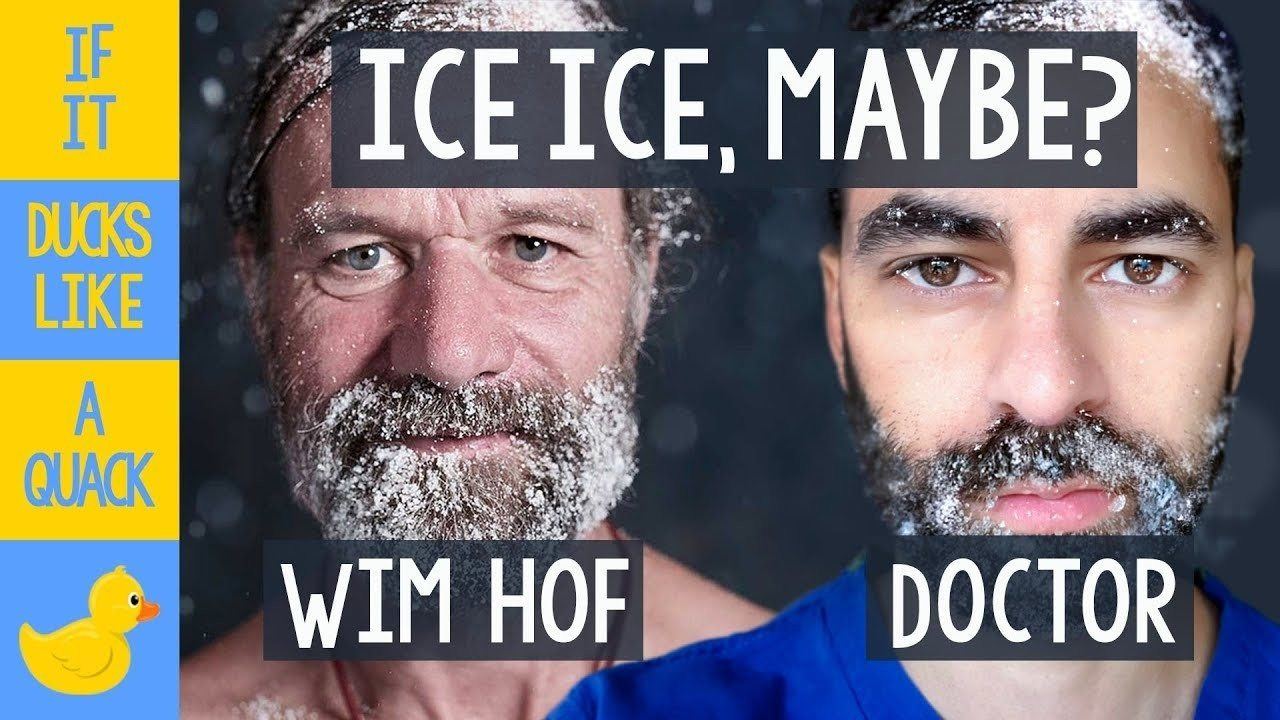
If you want a scientifically accurate and compellingly written account of not only the Wim Hof method but the grand philosophy behind it, then I highly recommend having listened to Scott Carney's what doesn't kill us. And I'm very pleased he'll be speaking to us shortly. There are some YouTube videos out there that purport to look at the science of the Wim Hof method, but they really just regurgitate the press releases from the official organization without turning a critical eye on the data themselves. Websites that talk about hacking the body are invariably for all the pseudoscience, so this video is an in depth, unnecessarily detailed and it most importantly critical look at the science of the Wim Hof method. For those of you that haven't watched the channel before, my name is Rohin and I'm a medical doctor and a university researcher with an interest in the extremes to which humans can push their physiology.
This video is going to be way longer than my usual one, so I'm timestamping the video in the description below so you can skip to particular areas that might interest you more than others. I'm going to structure this video based on the benefits, extolled on the Wim Hof method website and use the official Wim Hof method explained ebook a nicely packaged if somewhat fluffy, 32 page guide to the science behind the technique.
Obviously I wasn't just going to believe everything they said, so I've read pretty much every scientific paper in the area, certainly everyone referenced so that you don't have to, I'll start with an important point that this is an attempt to analyze the Wim Hof method. Not Wim Hof himself. Almost all the scientific literature is about Wim, but you might as well read or watch something about LeBron James or Usain bolt because these are elite athletes doing things that very few of us can do and despite the assertions that we make on a regular basis that anybody can do what he does, the fact that he holds so many worlds records suggest this isn't really true. So obviously I'll take a look at those studies and see what's going on inside women's body, but to then ask the key question that using the science available to us, will this work for you or for me?
I'll begin with Scott Carney explaining the general concept behind the Wim Hof method, which is what drew him in initially. And certainly what drew me in as well as someone with an interest in evolutionary science. If you think of humans as like natural creatures that we come out, we emerge 300,000 years ago in certain types of environmental conditions, uh, and our bodies, uh, in that time, it's sort of like this pre, like technologically advanced time. We were dealing with constantly varying environments and because our brains are sort of wired for comfort and our technological abilities have allowed us to modulate the environments about us so that we can, um, you know, essentially keep a homeostatic or pretty close to a homeostatic state like where, and by, by this, I mean your, your body doesn't have to do any extra work. Um, and you can sort of stay in this median area of, of, of comfort all the time that that has factored out the variations that we evolved with and created, uh, essentially a weaker physiology.
Um, and that if you assume that through evolution that change was constant now, um, that that constant has been taken out in favor of status. And this is making our bodies, uh, less robust. Because what happens is when you narrow that range of area where you can that, where you feel comfortable, um, you narrow your ability to, uh, thrive in extra environments. And then certain systems that are used to, um, to adapt to variations become underused and um, you know, uh, go essentially torment, you know, they're, they're, they're underutilized and that makes your physiology weaker. You know, I don't know why I found this idea so compelling. You'd be forgiven for thinking. I've got a bit of an obsession with hypothermia. I've made two videos about the cold effect on the body and one about breath holding and breathing.
And these form two of the three pillars of the Wim Hof method. The third being meditation, none of these are new ideas. People who have been practicing elements of the Wim Hof method probably for thousands of years. The Wim Hof method draws heavily on yoga, specifically Domo or Chan, Dolly yoga, which, uh, uses breathing to generate heat and pranayama, which is a whole practice of deep breathing in the Wim Hof method. Specifically it is cyclical hyperventilation, so this is breathing heavily and then followed by hyperventilation or breath holding. This causes initially a drop in carbon dioxide when you blow that out, whilst you're hyperventilating, which is called hypo capnia. And then hypoxia, which is low oxygen, which is caused by the breath hold. Or she Mondays or yogis have been meditating at top mountains in the Himalaya wearing nothing but a loincloth for hundreds of years. But I think what sets Wim apart is that he has happily invited scientists in to study him.
And this makes a welcome change from a lot of the other gurus who are out there and unwilling to back up what they see. Because in the absence of scientific study, you have people like Gwyneth Paltrow and the whole multimillion dollar wellness industry conversing what should be rational scientific discussions about the potential benefits of something like yoga meditation or the Wim Hof method into conversations about communing with the cosmos and crystals and all kinds of rubbish. I also asked Scott who spent much of his career debunking false gurus, what set him apart from some of the charlatans he's met in the past.
So when I first met Wim and first heard about him, he was making claims that were way too grand, right? That his breathing method has cold, would cure basically everything under the sun. And this is what happens in the wellness industry in general. They make claims that are often far too big. Um, but, um, he also made these claims that you would, I would be able to like control my body temperature in the snow and do more pushups and things like that. And, uh, I figured that, you know, you're, you're, if you're, if you're wrong about something, you're going to be wrong about everything. Um, go there, try his method. And I was, um, I mean I was really shocked that, uh, not only that it worked, but it worked very quickly. Like I adapted to a cold environment within the matter of a week. You know, I was doing things that were unexpected to me, which was, you know, I was living in Los Angeles before and then I was climbing up this mountain in Poland.
You've probably seen the videos would probably show some of these videos, um, of people like going shirtless with the mountain. And I felt really warm. And that was very counterintuitive. And I think because the Wim Hof method is very quick, um, it, it has the ability to change someone's mind about their expectations for their own body very quickly. And I think that sends very powerful messages, not only to, you know, about your own personal physical limits, but I also think that it creates sort of a, a new perspective on the world in general about robustness, about your ability to interact with things and about, you know, interestingly to control parts of my body that I did not think I had control over or at least influence parts of my body that I couldn't influence. Uh, and that was really remarkable.
So let's get to the science. This is going to be our running order. Number one is how does Wim resist the cold, what's actually happening in his mind and body number two, what's all this business about? Brown fat. Number three, do breathing exercises really have a measurable effect on physiology. Number four, probably the most outlandish claim about the Wim Hof method, can it actually affect your immune system? And number five, can the Wim Hof method prevent altitude sickness, the body regulated temperature via the central nervous system and the endocrine system mediated primarily by the hypothalamus, the anterior hypothalmic nucleus to be exact. However, the sensation of cold can be modulated in the brain. I think we've all experienced this. If the adrenaline's pumping for whatever reason, you don't really feel cold, but once you calm down, you realize it's quite a chilly day. The ancient practice of Domo meditation by Tibetan monks, it said to allow practitioners to generate heat from within.
There's not a great deal of evidence about it out there, but luckily there is one very useful study from a few years ago which showed that the monks generate heat from the physical work of forceful breathing, but this on its own could not be maintained for very long without the associated meditation. So you need both elements to really get the benefit from it. And we'll see this pattern repeated in tests of the Wim Hof method. A team out of Wayne state in Detroit performed a key study on Wim by scanning him whilst he was cooled by a clever suit using an MRI scanner to detect the following. Two changes in Wims. Brain number one W was able to activate primary control centers in an area of the brain called the periaqueductal gray to modulate the sensation of code number to higher cortical area is associated with introspective concentration and focus lit up.
The major potential confounder here is that the sudden changes in carbon dioxide levels that we mentioned earlier caused by hyperventilation can affect blood flow. Carbon dioxide is a potent vasodilator. It opens up blood vessels, so the changes detected on the fr. MRI scan might simply be related to changes in blood flow rather than inherent brain activity. However, these changes are replicated and other studies about meditation, so I would be happy to say that these are likely to be genuine changes. What this means is that women's ability to tolerate cold in a large part comes from his mind telling his brain, if you like to ignore the cold sensation. The authors also went so far as to say that much of the feel good effects of cold exposure comes from placebo, which is not to trivialize it. People often hear the word receiver and think it's a criticism, but it's actually a reflection of the body's immense power to change its own physiology and I'm all in favor of harnessing it as long as nobody is getting conned.
So what's all this about? Brown fat. If you've read anything about the science behind the Wim Hof method at all, you've undoubtedly heard of Brown fat or more correctly Brown adipose tissue, B, a T seven in a nutshell, there are two types of adipose tissue fat in the body, white and Brown fat. Sometimes you'll hear beige mentioned, we'll ignore that for now, white fat is used for energy storage and that's the stuff that when you have too much of it, you become obese. So we're all very familiar with what white fat is. Brown fat is a much more rare species. We all have Brown fat. We have a lot when we're babies and we gradually reduce the amount we have as we get older. We used to think not long ago, just about a decade ago that we lose Brown fat entirely as adults, but studies in the last 10 years or so have shown that adults do have small stores of Brown fat.
Um, and this is used for non shivering thermogenesis. That means generating heat thermogenesis. So there are different ways to generate heat. Obviously one is shivering by working your muscles and non shivering. Thermogenesis is what Brown fat does. For a long time it was believed that Wims repeated cold exposure allowed him to activate his Brown fat in a special way. And despite the studies disproving this taking place about five years ago, you'll still see websites mentioning it, but it's not true. Two studies have looked at Wim Brown fat and they use positron emission tomography coupled with CT pet CT along with the aforementioned MRI to take a detailed look at his anatomy. What they found is that women does not activate Brown fat in a remarkable way at all. It barely lit up. However, he does have more Brown fat than is typical for someone of his age.
Is this caused by repeated exposure to code? Well, in a truly incredible cosmic case controlled coincidence, Wim has an identical twin brother who doesn't follow the Wim Hof method. He's got a sedentary lifestyle without the frequent cold exposure, so it offers an amazing opportunity to actually study some of these changes, and I think I speak on behalf of all medical researchers when I say that life would be so much easier if we all had a clone stuck in a, in a cupboard somewhere that we could take out and study from time to time. I'm joking. Of course. Women's brother also has high levels of Brown fat, in fact, slightly higher. So it does seem that in this regard, at least the Hofs are genetic outliers and it's likely that this contributes to women's ability to withstand the cold. The Wim Hof method hasn't been shown to increase Brown fat levels, but mice do increase their levels in response to repeated cold stimuli.
The jury is still out when it comes to humans. The research show that Wim muscles of breathing, the intercostals that are between your ribs lit up like Christmas trees generating large amounts of heat. Now remember the pattern that we saw with the Tibetan Tomo monks? Exactly the same that uh, both Wim and the monks are generating a lot of heat from the physical work of breathing. And if you think about all the blood coming back into the chest, going through the myriad is in the lungs, this is an effective way to maintain blood temperature by exchanging heat from these muscles into the blood stream. It's exactly the same as what happens when you go for a run on a cold day. Within a few minutes, your body's generating enough heat to make you feel hot even though the temperature's cold. So it's nothing very exotic, but it's effective.
And I think this is a really nice way of explaining in a small part how Wim does what he does. This graph is quite striking. It's skin temperature. The blue circles are normal controls, normal people. And the hollow red circles are when Wim is just relaxed. He follows the same cycle of his skin warming. And cooling as the suit that the participant is wearing is warmed and cooled. However, the filled red circles at the top are Wim when engaging with the Wim Hof method, and as you can see, his skin temperature barely changes irrespective of whether the suit is hot or cold. So the authors concluded that without any outlandish physical findings, the majority of women's ability to tolerate cold actually comes from his mind and activation of the sympathetic nervous system, which we'll come onto in a little bit. Take a deep breath because now we're going to talk about the breathing aspect of the Wim Hof method for healthy people.
It's the level of carbon dioxide in your blood and your lungs that determines your urge to take a breath. Hyperventilation, as we mentioned earlier, blows off carbon dioxide at a much higher rate than normal, which is why you can hold your breath for much longer after hyperventilating because it takes that much longer for carbon dioxide to reach the level at which your body feels the urge to breathe. Come dioxide is also a weak acid, so reducing the amount of carbon dioxide in your blood trans in makes your pH go up, making a blood slightly more alkaline. Rhonda Patrick interviewed Pierre capital as well as Wim actually, and they focused on the fact that blood pH was noted to rise. Are you becoming more alkaline with deep breathing? And confusingly, Dr. Patrick and professor Cappo seemed quite wowed by this observation, which is odd because any doctor who has treated a patient with a mild asthma attacks, severe pain or even a panic attack, some reason that's causing them to hyperventilate, we'll have seen a markedly elevated pH. Making your blood slightly alkaline with deep breathing is nothing noteworthy at all.
It's seen in emergency departments on a daily basis and arterial blood gas is a special type of test. Looking at the partial pressures of different gases as well as the acid base status of somebody's blood and a normal healthy person at rest will have an ABG result that looks something like this. pH is normally 7.35 to 7.45 oxygen is say 14 and carbon dioxide 4.5 this is in kilopascals. I'll put freedom units in later. If that same person hyperventilates for maybe 10 minutes without any special training, the ABG might look something like this. Now the oxygen hasn't changed much as the partial pressure of oxygen in the air is of course fixed unless you inhale concentrated oxygen. But you can see that the CO2 has dropped right down to 1.3 and pH has risen to 7.67 which is exactly the kind of range you see in some of the studies of the Wim Hof method.
Uh, Daniel Beard, a professor of physiology at the university of Michigan gave some responses to a study that demonstrated this transient alkaline blood work of Wim Hof method practitioners explaining that we don't know whether this is short or long term. None of these people have control over their blood pH or their breathing, except when they're actually consciously doing this thing. Their heart rates are the same as other subjects. Their pressures are the same. In other words, the physiological changes that are seen might only last for the period of time when the participant is actually doing the Wim Hof method breathing. What we're lacking is a trial looking at how long these physiological changes last for eight 1224 hours. The things like pH won't last long at all because your body has such effective homeostatic mechanisms taking you back to a normal range, but some of them may be longer term.
The increase in pH is a key component for a particularly interesting reason. It may be related to improved cold tolerance. Nociception is the body's detection of pain, which is mediated by specific sensory neurons or pain detecting nerves. A component of these nociceptors is acid sensing ion channel three which is a key target for pain killing drug research and is quite sensitive to pH. A drop in pH activates them like an acidic burn, but a rise in pH two around the levels achieved by hyperventilation can actually deactivate them effectively improving the pain threshold. So this is actually a pathway that explains why deep breathing can improve tolerance to a noxious stimulus like cold. The Wim Hof method, employers not only hyperventilation but hyperventilation breath holding and this achieves a transient hypoxia or low oxygen level in the blood, which appears to kickstart the sympathetic nervous system, the fight, flight fright response.
Try saying that fast. Um, and this is probably the key step in the whole process. It's believed that a physiological stress after priming the sympathetic nervous system in this way releases endocannabinoids causing a pleasurable sensation. Accounting for the euphoria, uh, achieved, uh, with an ice bath. And it also explains something like the runner's high, that pleasurable sensation after physical stress. A mantra that you'll see repeated in every article about the method and in the official ebook is that medical opinion is that humans cannot exert an effect on the autonomic nervous system making effects observed in Wim, apparently miraculous. However, this is clearly nonsense. The autonomic nervous system includes things like heart rate and blood pressure and these can both be affected with simple relaxation or meditation, making them go down or the opposite. If you work yourself up into an anxious state, they can both go up well.
Autonomic nervous system also includes things like sneezing and you can overcome the urge to sneeze with a bit of practice in Scottsburg chemo accurately States that we didn't previously think that a person could voluntarily affect their immune system. Although even that comes with a slight caveat in that that's exactly what the placebo effect is. Marked changes in immune system response can be observed purely based on a person's belief about what the outcome will be. Uh, even with an inert substance, um, whether you want to call that involuntary or conscious or the power of positive thinking is entirely up to you. One of the marquee claims about the Wim Hof method is that it can modulate the immune system and this is backed by the most compelling of all the trials I read as it looks at real normal people, not Wim Hof himself. 12 people were trained for 10 days in the Wim Hof method and tested against 12 people without training.
The study protocol was the same as a study performed on Wim himself. Earlier on, participants were injected with an endotoxin which is a component of e coli, a common bacterial infection, which is used in experiments to produce a transient unpleasant but ultimately harmless syndrome of infection. In comparison to the control group, the people who didn't have any training, the intervention Wim Hof group reported fewer flu like symptoms after the injection. Things like headaches or my legs, but these are subjective so I'm not sure they really tell us very much. However, some objective measurements were taken as well. The intervention group had a similar response to Wim when he was tested, namely in comparison to the control group, they had a transient or spiritually alkalosis as we mentioned before, which is caused by hyperventilation, a markedly elevated adrenaline level, but no difference in cortisol. The stress hormone between the groups, increased levels of anti inflammatory cytokines probably released in response to the adrenaline. Things like interleukin 10 and the levels of proinflammatory cytokines were lower.
Things like TNF alpha and interleukin six and eight Unlike meditation studies which have shown changes in blood pressure and heart rates, which work by the parasympathetic nervous system. The thing I find really interesting about this is it works via the sympathetic nervous system, which as we mentioned earlier, is the kind of fight, flight fright, a system, the elevated levels of adrenaline. A significant adrenaline is a key constituent of the sympathetic nervous system pathway. The use of a control arm hairs to be applauded. It adds a major dimension to previous studies which have just looked at Wim on his own. Those are known as case studies. They're the lowest form of evidence in medicine. However, this doesn't eliminate the possibility of placebo effect at all because both arms are unblinded. Being blinded means you don't know whether you're in the intervention or the control arm. You may have heard of a double blind trial. That's the gold standard.
That's where the clinicians, the doctors and other healthcare professionals involved in trial also don't know whether a participant is in the intervention or the control arm. Obviously none of that's possible here because you can't blind people to whether they're in an intervention arm. If the intervention involves 10 days worth of ice, cold water and meditation and indeed the authors wrote a followup paper about how optimism and the mental expectation of the outcome affected the result, which is the very definition of the placebo effect. Let's take a look at a clip from the Curiosity Stream documentary as well.
We know that longterm stress hormone is very damaging. Chronic stress or conditions like Cushing's disease, which is a pathological elevation in cortisol. That stress hormone that we mentioned earlier can have hugely damaging effects to health, but short term controlled stress appears to have tangible benefits. The concept of good and bad stress is something that Scott goes into in quite a bit of detail in his book. It's the reason that, uh, things like those hardcore salt courses have exploded in popularity in recent years. Our lives have become unrecognizably comfortable in comparison to 99% of our existence on this planet. And whilst we're familiar with testing ourselves physically, we rarely expose ourselves to extremes of temperature. This is a normal daily cortisol pattern. It's highest in the morning and varies over 24 hours. While it isn't a direct correlation to stress, let's just imagine for now that it can represent overall stress in response to a short term stressful situation like a viral illness or climbing a mountain, it will peak chronic stress looks like this elevated across the board, and that's what's harmful.
Stress is a disease. People, perhaps an ideal scenario would look something like this, a low general level of stress facilitated by good physical and mental health through whatever works for you, but a more potent response when needed, which can be modulated by conscious efforts such as the Wim Hof method. What about climbing a mountain? Yeah, it does do it. I won't spend too long on this because it's likely that only a small proportion of your viewers are going to be scaling tall mountains. But for me it was one of the most remarkable things I heard about the whole Wim Hof method. The fact that Wim successfully took groups of essentially novice climbers to the top of Mount Kilimanjaro, which is just shy of 6,000 meters in only two days instead of the suggested four or five with extremely low levels of dropout due to altitude sickness was amazing. You know, as someone who's been to altitude and treated people without state sickness, um, that was, I mean, forgive the pun, but really breathtaking. And do you, do you think it was just a products of the conscious hyperventilation and avoiding that kind of hypoxic hyperventilation, or do you think that there was some additive effect from the other aspects of the, the methods?
Yeah, I think that it was because I had been doing the training consistently for six months to a year beforehand. And not everyone on the program had somebody like, you're supposed to do it that way. But a lot of the people hadn't done it that way. And those, these were the people who didn't make it up with my group, which was just three people. And I remember Wim had this crazy thing at the top of the mountain where he went nuts and we had to, there was a mutiny like there, there were issues going on, but I attribute it to the rapid breathing the entire way up. Right? So essentially what Diamox does, as far as I'm aware, right, is it is, it makes you breathe Ram more rapidly and you pee more. Right? Um, and, and, and what we're doing is we're consciously doing essentially what Diamox does by breathing a lot more consciously from a low level to a high level.
Um, you know, we, we, we kept that, that oxygenation up. And if you actually go to a mountain, you know, next time you're climbing something big, um, you can notice that your OTU, if you use an oximeter, you will notice that your OTU might get low. You know, maybe you're in the 70s, maybe, you know, you know, and it sort of stays chronically low if you're not working on it. But you will notice that if you have that pulse oximeter on your finger and you do the Wim Hof breathing without the retentions, you'll notice that your OTU two goes back up immediately. Um, and it just goes right back. You know, you could just, we could just watch it go from in the 60s for somebody all the way up into the 90s and sort of stay there. And then if you just keep on doing the breathing, you, you're able to compensate.
And so I think this is actually something that every Mountaineer doing high altitude stuff should be trained in as an idea, you know, because it's just something that you can do and can probably save some people's lives. Uh, I think that there is a mindset part to this. Like there is this feeling of fighting the environment versus working with the environment. And that is like this quasi, almost spiritual thing that comes out of my experiences that, you know, I end the book with the cheesiest line in, in literary history where I say, I am not on the mountain. I am the mountain. And I know it's cheesy, but it's, it's the way I feel. And I think that there's a real lesson here that comes out of it, is that, is that I've gotten up this mess up Kilimanjaro, not because I was fighting everything because I just accepted it and I said, okay, we're going to do this.
And there was a calmness to it versus a relationship of adversary adverse adversary and this adversesality. I don't know how to say that word. I know what I mean. Adversity, right. It's not, it was not adversity. Um, and uh, and I think that gives some element of resilience. I don't think it makes it impossible for bad things to happen. Um, I think that the, what we're doing with the Wim Hof method is you're expanding your range of ability to exist in an extreme environment. Um, and, and get right up to that point where you know, your, your nervous system and your body there, there's, there's a, you ring up alarm bells very early before you get to damage or death. It's like, Whoa, wait there you're going to get damaged. And it's usually very conservative. So what the Wim Hof method does is allows you to push closer to that barrier of where the damage happens and maybe pushes that damage thing a little bit further. What Scott's referring to there is hypoxic ventilatory response. It's difficult to predict who will get altitude sickness, but probably the best predictor is someone's hypoxic ventilator response.
This is how their body reacts to low oxygen environments. Some people increase their respiratory rate more than others, and the ones who tend to get more altitude sickness are the ones who don't Mount that increase in respiratory rate. If you are deliberately consciously taking deep breaths, you circumvent any problems with having a poor hypoxic ventilator response and you ensure that you're getting as much oxygen as possible rather than hyperventilating. The drug that Scott mentioned is this acetazolamide or Diamox and it works by creating a mild metabolic acidosis in the body. And so that forces you subconsciously to breathe harder and blow off carbon dioxide to correct the pH back to normal. And as a byproduct, you do extra breathing and you get more oxygen. The first expedition wasn't published as a paper, but as a letter to a journal and concludes by saying that they don't encourage people to ascend mountains very quickly. But if needed, for example, the mountain rescue team, Domo meditation or the Wim Hof method can help.
And I agree. So before I get to my conclusion, why don't we categorize every point made on the Wim Hof method website? Every potential benefit into one of three categories. Number one, probable benefit or probable that has this effect. Number two possible meaning that the evidence is rather weak, but there's a little, and the third category is no evidence. Now this doesn't mean it doesn't achieve this effect. It doesn't mean that it's false. It doesn't mean that anybody's lying. It just means that I can't see any clear evidence that can back up this claim. So first into the probable category, I would put short term effects on the immune system. I think that was a nicely shown. Positive effects on mental health, stress, sleep and willpower. Well these often go hand in hand and um, the Wim Hof method clearly appears to help a lot of people, but more than that, these are benefits that have been shown to be achievable through many different programs of meditation and discipline, sort of routines like this arthritis relief.
I think more research needs to be done here but um, called exposure. This is out to with the Wim Hof method. Looking at other research involving cold exposure does appear to have some beneficial effects on inflammatory types of arthritis. Although again, I don't know how long term some of this is. Next in the probable category I'm putting asthma and COPD management, not a cure but management and the reason I'm confident of putting these here is because we know that one of the best treatments for people taking control of the asthma and COPD, COPD, is chronic obstructive pulmonary disease, chronic lung disease like emphysema is respiratory physiotherapy and these are specialists, physiotherapists who work with patients with these conditions to teach them coping mechanisms and ways to regulate their breathing to prevent getting into those episodes where they become very short of breath. So it's no surprise that a program which has breathing controllers central to it will be beneficial.
Also in the probable category I'd put improved cold tolerance and finally having an effect on reducing the likelihood of altitude sickness, which for me is quite astonishing in the possible category. I'd put improved energy because this is just a bit vague and I don't really think it's well defined, improved workout recovery. Well this is a difficult one. There's been a lot of work to do with ice baths off to training. I mean this is something that was routine when I used to do athletics years ago. It's kind of fallen out of fashion a little bit. Um, evidence is a little conflicting. And then I'd put arthritis relief in the no evidence column. I'm putting longterm effects on the immune system. Sporting performance. Again, this is a bit wishy washy. It could have gone in the possible column really in terms of just overall improved physical fitness.
Why not? Um, but I don't know if we've seen any hard evidence that the Wim Hof method has caused longterm improved sporting performance. Then I'm putting fibromyalgia and chronic Lyme. These are two conditions which are very hard to define, very hard to treat. Uh, and um, a lot of people self-diagnose. So we're treating a very heterogeneous patient population and I've seen classes, about the Wim Hof method specifically advertised for both fibromyalgia and chronic Lyme, which makes me a little bit uncomfortable because I can't really see what that's based on. And finally Parkinson's. Again, this is something that I feel a little uncomfortable saying that the Wim Hof method will be beneficial for all because we really don't have any evidence to see that. So in conclusion, I know this has been my longest video ever and probably will remain my longest video. So if you skipped directly here from the introduction, then shame on you, but I probably would have done exactly the same thing. All I ask is that if you have found this video useful or any of my other videos, I don't have a Patrion account or anything like that, so please just stay watching till the end of the video for the sponsoree. That's all I ask
The Wim Hof method does definitely appear to offer significant health benefits. The effects appear to be mediated by a good stress activating the sympathetic fight, flight or fright response in a controlled way through breath holding and again through cold exposure. It's difficult to tease out which elements do what, although perhaps that's not important if you're going to do them all anyway, but cold exposure probably has the least evidence with a committed program of meditation and breathing exercises actually having a body of hard science behind them. Cold exposure with proceeding, sympathetic nervous system priming with the breathing is what is likely to help. Cold exposure alone is of questionable use, but of course that's not what they Wim Hof Method advisers, a major unanswered question is how transient some of the effects are like the immune system modulation. We don't know if there is any residual benefit outside the period immediately after performing deep breathing exercises.
Common sense dictates that things like improved mental health in general, physical fitness are of course longer lasting. So I'm not at all saying there are no longterm benefits from the method only that we don't have the evidence one way or the other. But for the reasons I explained earlier, we can never do a randomized double blind controlled trial. So I feel that there is convincing evidence that a lot of people get longterm benefits from the technique. Is the Wim Hof method the only way you can access these benefits? Definitely not, but it's never claimed to be. And I think the reason it's been so successful is a, the charisma and feats of its creator. B, it's very simple, essentially free. See it cuts through a lot of the mystical mumbo jumbo that sometimes comes packaged with other courses about meditation and breathing, which can't be said for a lot of the websites and videos based on the Wim Hof method, uh, who had a generous helping of exaggeration.
So overall I would have no concerns recommending it. What I might say to someone asking about it is give it a try. It has helped lots of people and it's unlikely to cause harm. If you follow some simple advice. Are you going to be able to accomplish the same feats as Wim Hof? No. But just because you're not going to become Michael Phelps, it doesn't mean you shouldn't take up swimming. Can a lot of the benefits be explained by the placebo effect? Yes, probably at least some. So you might wonder why I'm supportive of this versus other topics I've covered on this channel. Well, for the simple reason that as long as you follow the basic advice, the Wim Hof method has little potential for harm, unlike say a very restrictive diet, uh, and it's not trying to replace conventional medical treatment unlike something like say homeopathy and naturalpathy.
And I think if either of those things are suggested, which I have seen on personal blogs about the Wim Hof method, then I would run a mile. I think that's an important message to send sometimes us doctors can be regarded as unwilling to try new things, which I don't think is true. It's just that we require sufficient evidence that the potential benefits outweigh the potential risks and I feel that the Wim Hof method fulfills that. To reiterate my earlier point about the placebo effect, if a particular ritual or regime helps you tap into the placebo effects potential, why not take advantage of it? I would much rather you went for a walk in the cold every morning and reap the benefits contained there in like getting out into nature exercise and the good stress of a bracing cold morning rather than hand over your hard earned to a crack for some magic beans.
I get uncomfortable when people exaggerate the potential benefits of the Wim Hof method and you don't have to Google for very long to find these kinds of comments and claims, so don't regard it as a miracle cure for any specific condition, but more a potential pathway to better overall physical and mental health. You'll notice in much of the literature and videos, a disclaimer that Wim Hof breathing and submersion in water should not be mixed. They should be done at different times. This was brought home to me very starkly when I posted on Instagram after I'd interviewed Scott and I got a message from a guy whose best mate had died at only 19 years old, drowned whilst attempting Wim Hof breathing in water. Also, I would exercise caution regarding cold exposure for anybody with heart disease. A buddy of mine did his PhD in cold air inhalation precipitating heart attacks.
The reason that so many older people die shoveling snow every winter, so if you're over the age of 50 or you have a background of heart disease, please consult your doctor before starting. The cold shock response is a phenomenon that kills people who fall overboard in cold waters. It effectively paralyzes you and causes a sharp intake of breath. So sensible advice for everyone, irrespective of your initial health is don't leap into Arctic waters on your first date. Take things slowly and you should be fine. I'll do my best to answer any questions in the comments below, so please fire away. Um, feel free to share your experiences of the Wim Hof method. If you disagree with anything I have said, I'd be keen to hear from you. So please do leave a comment. Thank you for watching this fast. Sincerely, this video wouldn't have been possible without the support of curiosity stream.
If you want to support this channel as well as get access to two and a half thousand high quality documentaries like the one featuring Wim Hof. Then if you sign up or the link below using the code Medlife, you will get one month absolutely free. You can watch the documentaries offline. And as a parent, I was also very excited to see that they have now got a kid section two, which is brilliant as your guaranteed safe educational material rather than on YouTube where there are all kinds of weirdos. I know people have come to expect jokes from this channel and this video was pretty serious. So to make up for it, I filmed the entire thing, not wearing any pants.