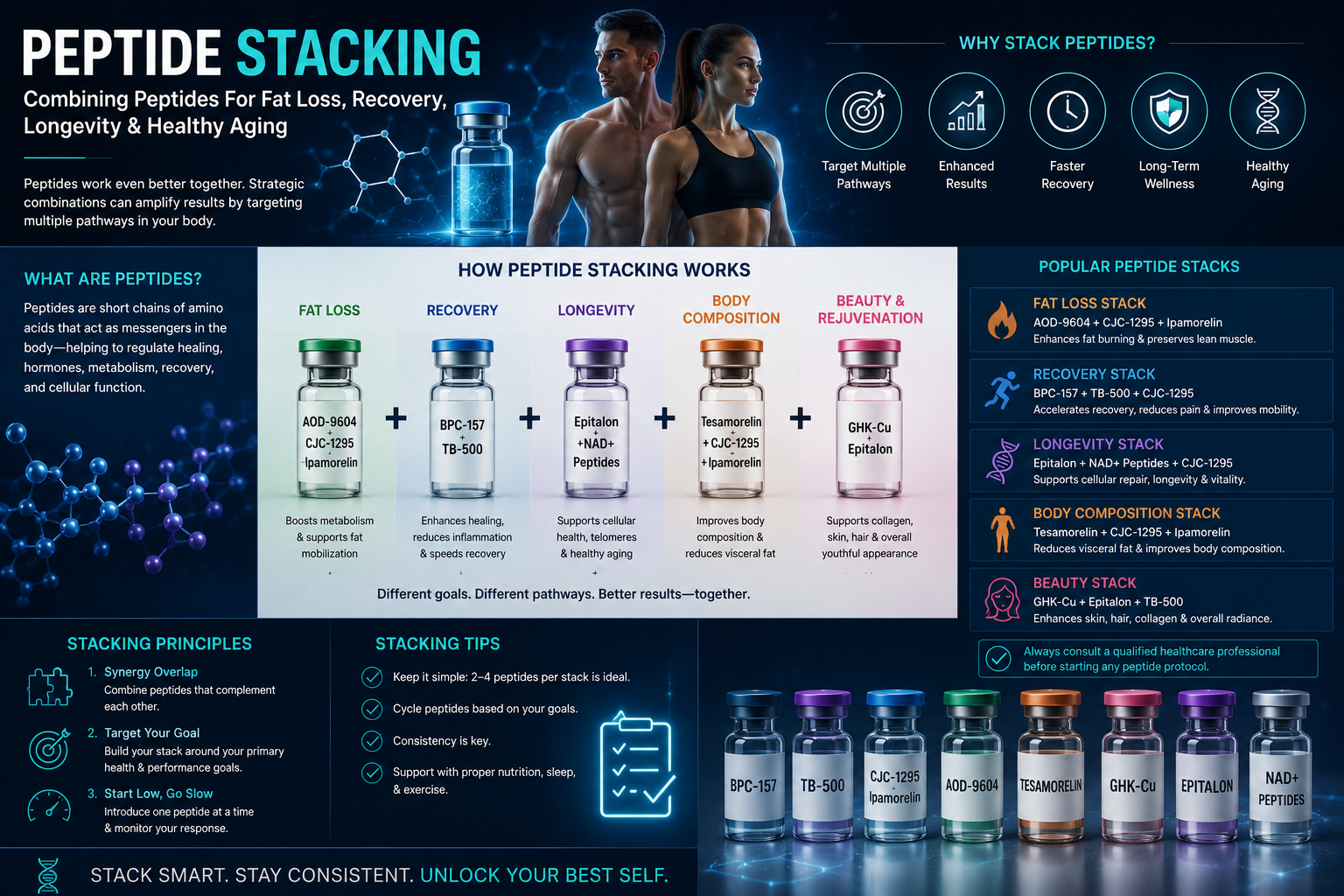
Chapter 16: Peptide Stacking
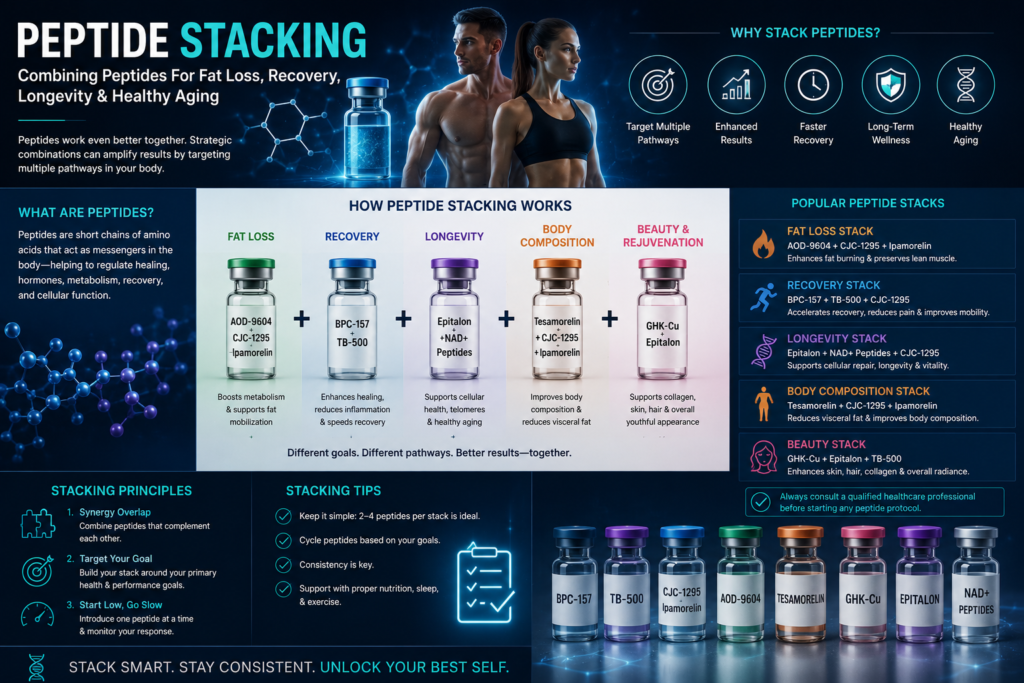
Combining Peptides For Fat Loss, Recovery, Longevity & Healthy Aging
Once women begin learning about peptides, one of the first questions that naturally comes up is:
“Can these peptides be combined together?”
In wellness and longevity communities, this is commonly referred to as:
peptide stacking.
A peptide stack simply means combining multiple peptides with different goals or mechanisms in mind.
For example:
- one peptide may focus on appetite regulation
- another may support recovery
- another may support sleep or body composition
The idea is to create a more comprehensive wellness strategy rather than relying on one compound alone.
And honestly, this makes sense.
Because real wellness is rarely about solving only one issue.
Women navigating midlife are often dealing with several overlapping challenges simultaneously:
- weight gain
- inflammation
- poor sleep
- reduced recovery
- low energy
- hormonal changes
- muscle loss
- stress
- metabolic slowdown
Which is why stacking conversations became so popular in:
- longevity clinics
- wellness communities
- biohacking culture
- metabolic optimization discussions
Important Reality Check Before Discussing Stacks
Before we talk about common peptide combinations, it’s important to say this clearly:
more is not always better.
One of the biggest mistakes in wellness culture is assuming that:
- adding more compounds
- taking more supplements
- aggressively optimizing everything
automatically creates better results.
It doesn’t.
In fact, excessive stacking can sometimes:
- increase side effects
- complicate recovery
- create unnecessary stress on the body
- make it harder to identify what’s actually helping
The healthiest wellness strategies tend to be:
thoughtful, intentional, and sustainable.
That mindset matters enormously.
The Most Common Reasons Women Explore Stacking
Women typically become interested in peptide stacks for four major reasons:
- Fat loss & metabolic support
- Recovery & inflammation reduction
- Sleep & healthy aging
- Body composition & longevity optimization
Let’s break down the most common wellness-oriented approaches.
Stack #1
Metabolic & Fat Loss Support
Commonly Discussed Combination:
- Semaglutide or Tirzepatide
paired with: - AOD-9604
Why Women Explore This Combination
This type of stack is often discussed by women focused on:
- appetite control
- metabolic support
- body composition
- reducing stubborn abdominal fat
The idea is that:
- appetite-regulating peptides may help reduce cravings and overeating
while: - AOD-9604 is discussed in relation to fat metabolism support
Again, results vary considerably between individuals.
Important Considerations
Women using metabolic-focused stacks should pay close attention to:
- protein intake
- muscle preservation
- hydration
- resistance training
- nutrient quality
Rapid weight loss without muscle preservation may create:
- weakness
- metabolic slowdown
- fatigue
- poor long-term outcomes
Healthy body composition is not simply:
losing weight quickly.
It’s maintaining:
- strength
- resilience
- metabolic health
Stack #2
Recovery & Inflammation Support
Commonly Discussed Combination:
- BPC-157
paired with: - TB-500
Why Women Explore This Combination
This is one of the most commonly discussed recovery-focused stacks in wellness communities.
Women often become interested in it for:
- chronic soreness
- recovery support
- mobility
- tendon-related concerns
- inflammation support
- exercise recovery
Especially among women who want to:
- stay active
- maintain mobility
- continue strength training
- improve recovery consistency
The Bigger Wellness Lesson
One thing I find incredibly important here is that:
recovery is becoming mainstream wellness.
For years, women were taught to constantly:
- push harder
- exercise more
- ignore fatigue
- normalize exhaustion
But sustainable wellness depends heavily on:
- recovery
- nervous system regulation
- inflammation management
- resilience
That shift is long overdue.
Stack #3
Sleep, Recovery & Healthy Aging
Commonly Discussed Combination:
- CJC-1295
paired with: - Ipamorelin
Why Women Explore This Combination
Women interested in:
- sleep quality
- recovery
- healthy aging
- muscle preservation
- vitality
often become interested in this pairing.
Many women navigating midlife feel:
- under-recovered
- physically depleted
- chronically fatigued
This stack is often discussed within:
- longevity-focused wellness
- anti-aging conversations
- recovery optimization
Why Sleep Matters So Much
Sleep is deeply connected to:
- metabolism
- recovery
- appetite regulation
- cognitive function
- inflammation
- hormone balance
Many women underestimate how dramatically poor sleep affects:
- body composition
- cravings
- emotional resilience
- energy
Which is why recovery-focused wellness matters so much during midlife.
Stack #4
Longevity & Cellular Health
Commonly Discussed Combination:
- MOTS-c
paired with: - NAD+-focused wellness approaches
and occasionally: - Epitalon
Why Women Explore This Combination
This category is typically discussed by women focused on:
- energy
- longevity
- cellular health
- vitality
- healthy aging
- resilience
These conversations are especially popular in:
- biohacking communities
- longevity clinics
- advanced wellness spaces
The emphasis here is less about:
dramatic transformation
and more about:
maintaining function and vitality long-term.
Stack #5
Beauty, Recovery & Regeneration
Commonly Discussed Combination:
- GHK-Cu
paired with: - recovery-focused wellness
- collagen-supportive lifestyles
- metabolic optimization
Why Women Explore This Combination
Women interested in:
- skin quality
- healthy aging
- collagen support
- hair vitality
- regenerative wellness
often become interested in beauty-oriented peptide conversations.
And honestly, I think it’s important to normalize the idea that:
women can care about appearance without it being shallow.
Wanting to:
- look healthy
- feel confident
- age gracefully
is completely reasonable.
The Biggest Mistake In Biohacking Culture
One thing I’ve noticed repeatedly is that many people become obsessed with:
optimization overload.
They:
- chase too many compounds
- constantly switch protocols
- overcomplicate wellness
- ignore foundational health habits
But sustainable wellness almost always comes back to:
- sleep
- movement
- protein
- recovery
- stress management
- consistency
Peptides may support those goals.
But they cannot replace them.
The Importance Of Simplicity
The women who usually achieve the best long-term results are rarely the women doing:
- the most extreme stacks
- the most aggressive protocols
- endless experimentation
Instead, they tend to focus on:
- consistency
- realistic expectations
- sustainable routines
- gradual improvement
- recovery
- metabolic health
That’s the healthiest long-term mindset.
Safety & Professional Oversight
Because peptides can influence:
- metabolism
- hormones
- appetite
- recovery pathways
- growth signaling
…it’s important to approach stacking carefully.
Women should especially seek guidance if they have:
- hormone-sensitive conditions
- cancer histories
- metabolic disorders
- autoimmune conditions
- pregnancy or breastfeeding considerations
Quality and sourcing matter enormously.
So does realistic thinking.
Why Women Are Moving Toward Longevity Wellness
One of the healthiest things happening in modern wellness is that women are becoming less obsessed with:
- punishment
- perfection
- shrinking themselves
And more focused on:
- strength
- energy
- resilience
- confidence
- movement
- healthy aging
- quality of life
That shift changes everything.
Because wellness should ultimately help women:
feel more alive—not more exhausted.
Ava’s Perspective
If there’s one thing I’ve learned through exploring wellness and longevity, it’s this:
the body responds best to support—not war.
The women who thrive long-term are usually not the women punishing themselves constantly.
They’re the women who:
- recover properly
- nourish themselves well
- maintain muscle
- move consistently
- sleep deeply
- manage stress intelligently
- stay emotionally balanced
Peptides can sometimes support those goals.
But they work best when built on a strong foundation—not used as a substitute for one.
And honestly, I think that’s the healthiest possible way to approach modern wellness.
Key Takeaways
Wellness should focus on vitality, resilience, and quality of life—not punishment or perfection.
Peptide stacking means combining peptides with complementary wellness goals.
Common stack categories include metabolism, recovery, sleep, longevity, and regenerative wellness.
More compounds do not automatically create better results.
Recovery and muscle preservation remain foundational for healthy aging.
Sustainable wellness depends more on consistency than extreme optimization.
Quality sourcing and professional oversight matter enormously.