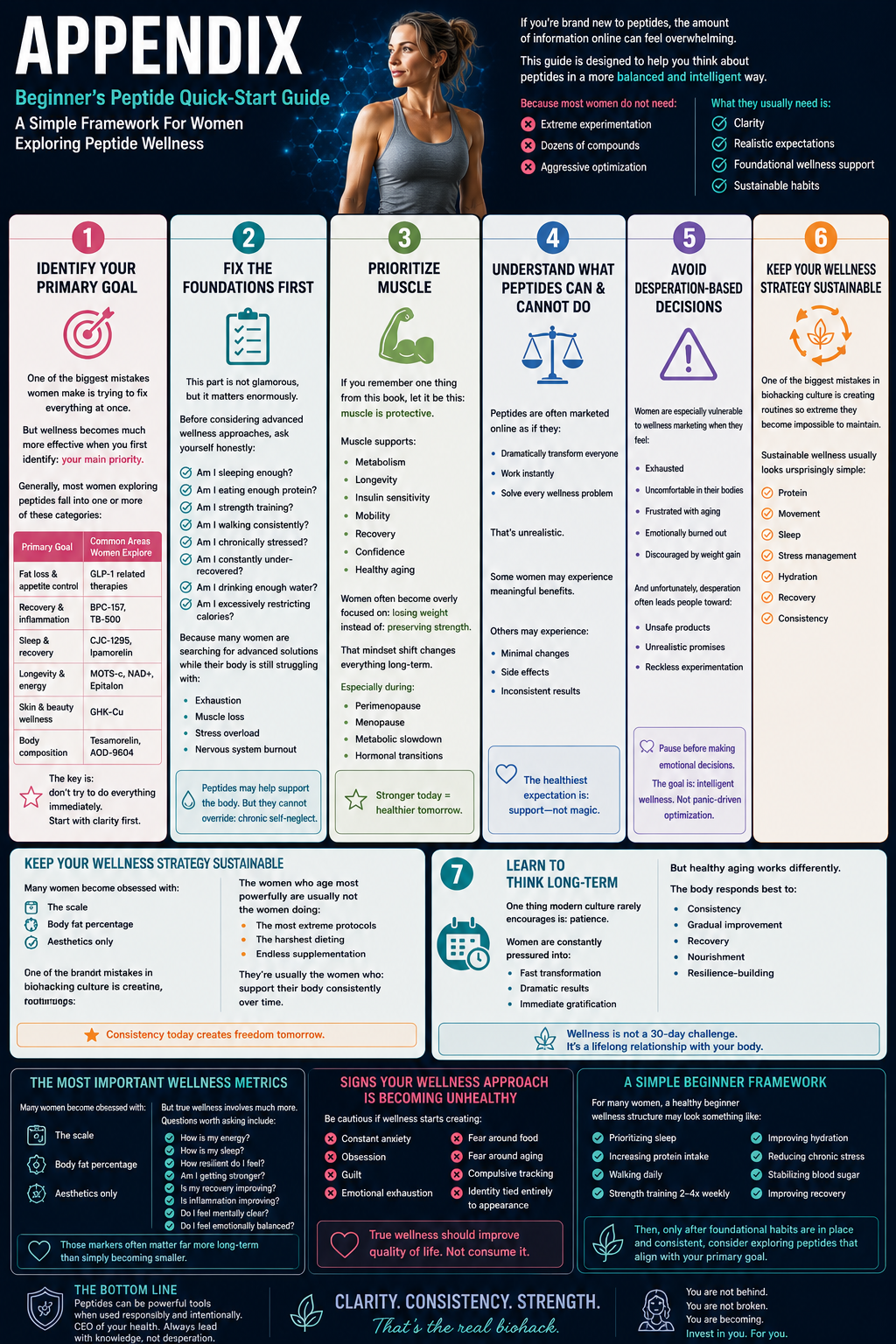
Appendix
Beginner’s Peptide Quick-Start Guide
A Simple Framework For Women Exploring Peptide Wellness
If you’re brand new to peptides, the amount of information online can feel overwhelming very quickly.
Between:
- social media influencers
- biohacking podcasts
- wellness clinics
- Reddit forums
- aggressive marketing
- before-and-after photos
…it can become difficult to separate:
education from hype.
So before diving into advanced protocols or complicated stacks, I want to simplify the conversation as much as possible.
Because most women do not need:
- extreme experimentation
- dozens of compounds
- aggressive optimization
What they usually need is:
- clarity
- realistic expectations
- foundational wellness support
- sustainable habits
This guide is designed to help you think about peptides in a more balanced and intelligent way.
Step 1
Identify Your Primary Goal
One of the biggest mistakes women make is trying to fix:
everything at once.
But wellness becomes much more effective when you first identify:
your main priority.
Generally, most women exploring peptides fall into one or more of these categories:
| Primary Goal | Common Areas Women Explore |
| Fat loss & appetite control | GLP-1 related therapies |
| Recovery & inflammation | BPC-157, TB-500 |
| Sleep & recovery | CJC-1295, Ipamorelin |
| Longevity & energy | MOTS-c, NAD+, Epitalon |
| Skin & beauty wellness | GHK-Cu |
| Body composition | Tesamorelin, AOD-9604 |
The key is:
don’t try to do everything immediately.
Start with clarity first.
Step 2
Fix The Foundations First
This part is not glamorous, but it matters enormously.
Before considering advanced wellness approaches, ask yourself honestly:
- Am I sleeping enough?
- Am I eating enough protein?
- Am I strength training?
- Am I walking consistently?
- Am I chronically stressed?
- Am I constantly under-recovered?
- Am I drinking enough water?
- Am I excessively restricting calories?
Because many women are searching for advanced solutions while their body is still struggling with:
- exhaustion
- muscle loss
- stress overload
- nervous system burnout
Peptides may help support the body.
But they cannot override:
chronic self-neglect.
Step 3
Prioritize Muscle
If you remember one thing from this book, let it be this:
muscle is protective.
Muscle supports:
- metabolism
- longevity
- insulin sensitivity
- mobility
- recovery
- confidence
- healthy aging
Women often become overly focused on:
losing weight
instead of:
preserving strength.
That mindset shift changes everything long-term.
Especially during:
- perimenopause
- menopause
- metabolic slowdown
- hormonal transitions
Step 4
Understand What Peptides Can & Cannot Do
Peptides are often marketed online as if they:
- dramatically transform everyone
- work instantly
- solve every wellness problem
That’s unrealistic.
Some women may experience meaningful benefits.
Others may experience:
- minimal changes
- side effects
- inconsistent results
The healthiest expectation is:
support—not magic.
Step 5
Avoid Desperation-Based Decisions
Women are especially vulnerable to wellness marketing when they feel:
- exhausted
- uncomfortable in their bodies
- frustrated with aging
- emotionally burned out
- discouraged by weight gain
And unfortunately, desperation often leads people toward:
- unsafe products
- unrealistic promises
- reckless experimentation
Pause before making emotional decisions.
The goal is:
intelligent wellness.
Not panic-driven optimization.
Step 6
Keep Your Wellness Strategy Sustainable
One of the biggest mistakes in biohacking culture is creating routines so extreme they become impossible to maintain.
Sustainable wellness usually looks surprisingly simple:
- protein
- movement
- sleep
- stress management
- hydration
- recovery
- consistency
The women who age most powerfully are usually not the women doing:
- the most extreme protocols
- the harshest dieting
- endless supplementation
They’re usually the women who:
support their body consistently over time.
Step 7
Learn To Think Long-Term
One thing modern culture rarely encourages is:
patience.
Women are constantly pressured into:
- fast transformation
- dramatic results
- immediate gratification
But healthy aging works differently.
The body responds best to:
- consistency
- gradual improvement
- recovery
- nourishment
- resilience-building
Wellness is not a 30-day challenge.
It’s a lifelong relationship with your body.
The Most Important Wellness Metrics
Many women become obsessed with:
- the scale
- body fat percentage
- aesthetics only
But true wellness involves much more.
Questions worth asking include:
- How is my energy?
- How is my sleep?
- How resilient do I feel?
- Am I getting stronger?
- Is my recovery improving?
- Is inflammation improving?
- Do I feel mentally clear?
- Do I feel emotionally balanced?
Those markers often matter far more long-term than:
simply becoming smaller.
Signs Your Wellness Approach Is Becoming Unhealthy
Be cautious if wellness starts creating:
- constant anxiety
- obsession
- guilt
- emotional exhaustion
- fear around food
- fear around aging
- compulsive tracking
- identity tied entirely to appearance
True wellness should improve:
quality of life.
Not consume it.
A Simple Beginner Framework
For many women, a healthy beginner wellness structure may look something like:
- prioritizing sleep
- increasing protein intake
- walking daily
- strength training 2–4x weekly
- improving hydration
- reducing chronic stress
- stabilizing blood sugar
- improving recovery
Then, only after foundations improve:
- thoughtfully exploring advanced wellness options if appropriate.
That’s a far healthier long-term strategy than:
chasing shortcuts immediately.
The Truth About Healthy Aging
The women who tend to age best are rarely:
- the women punishing themselves hardest
or - the women obsessing over perfection
They are usually the women who:
- nourish themselves well
- maintain muscle
- stay physically active
- protect sleep
- preserve emotional balance
- remain curious and engaged with life
Healthy aging is not simply physical.
It’s deeply emotional too.
Ava’s Perspective
If I’ve learned anything through wellness, it’s this:
the body responds remarkably well to support.
Not punishment.
Not panic.
Not perfectionism.
The more I focused on:
- recovery
- nourishment
- strength
- sleep
- consistency
the better my body responded over time.
And honestly, I think many women are far more exhausted from fighting themselves than they realize.
Wellness should feel:
- empowering
- grounding
- sustainable
- life-giving
Not exhausting.
That’s the mindset I hope women carry with them long after finishing this book.
Quick-Start Summary
Focus on:
- Protein
- Sleep
- Muscle
- Recovery
- Walking
- Strength training
- Stress management
- Consistency
- Realistic expectations
Avoid:
- Panic-driven wellness
- Extreme restriction
- Overtraining
- Obsessive biohacking
- Unsafe sourcing
- Miracle-solution thinking
- Fear-based anti-aging culture
Educational Disclaimer
This book is intended for educational and informational purposes only.
It is not medical advice and should not replace consultation with qualified healthcare professionals.
Many peptides discussed in wellness and biohacking communities remain:
- investigational
- experimental
- incompletely studied for long-term human use
Women should discuss any peptide-related therapy, medication, supplement, or wellness intervention with appropriately licensed healthcare providers—especially if they have:
- medical conditions
- hormone-sensitive conditions
- metabolic disorders
- pregnancy or breastfeeding considerations
- complex health histories
Individual responses, risks, and outcomes vary significantly.
Always prioritize:
- safety
- evidence-informed decision making
- realistic expectations
- professional oversight
- high-quality sourcing
Your health deserves thoughtful, informed care.
Appendix B
Peptide Glossary
Simple Definitions For Common Terms Used In Wellness & Longevity Conversations
One of the most confusing parts of entering the peptide and longevity world is the language.
Women are suddenly exposed to terms like:
- GLP-1
- growth hormone secretagogues
- mitochondrial function
- visceral fat
- insulin sensitivity
- inflammation markers
- bioavailability
- peptide stacks
…and it can quickly feel overwhelming.
So this glossary is designed to simplify the most common concepts discussed throughout this book in plain, easy-to-understand language.
A
Amino Acids
Small molecules that act as the building blocks of protein. Peptides are made from chains of amino acids.
Appetite Regulation
The body’s system for controlling:
- hunger
- fullness
- cravings
- food intake
Several peptides discussed in wellness communities are associated with appetite-related signaling pathways.
AOD-9604
AOD-9604 — A peptide commonly discussed in fat-loss and metabolic wellness conversations.
B
BPC-157
BPC-157 — A peptide frequently discussed in wellness communities for recovery, inflammation, and tissue-support conversations.
Biohacking
A broad term used to describe intentional efforts to optimize:
- health
- performance
- recovery
- longevity
through lifestyle strategies, technology, supplements, or wellness interventions.
Biological Aging
The internal aging process occurring within cells and tissues, which may differ from chronological age.
C
Cellular Health
A broad wellness term referring to how efficiently and resiliently cells function throughout the body.
CJC-1295
CJC-1295 — A peptide commonly discussed in recovery, sleep, and longevity wellness conversations.
Collagen
A structural protein important for:
- skin elasticity
- connective tissue
- joints
- healthy aging appearance
Collagen production naturally declines with age.
Compounding Pharmacy
A specialized pharmacy that prepares customized medications under regulated guidelines.
Cortisol
Often called the “stress hormone.” Chronic elevation may contribute to:
- abdominal fat gain
- inflammation
- sleep disruption
- fatigue
D
Dosage Range
A general amount commonly discussed in research or wellness conversations. This book intentionally avoids specific dosing instructions.
E
Epitalon
Epitalon — A peptide commonly discussed in longevity and healthy-aging conversations.
Estrogen
A major female hormone involved in:
- metabolism
- mood
- skin health
- bone health
- body composition
Estrogen levels fluctuate significantly during perimenopause and menopause.
F
Fat Loss
Reduction in stored body fat. Healthy body composition involves preserving muscle while reducing excess fat.
Functional Wellness
A wellness approach focused on improving:
- energy
- mobility
- metabolism
- resilience
- quality of life
not simply appearance alone.
G
GHK-Cu
GHK-Cu — A copper peptide commonly discussed for skin, collagen, and regenerative wellness support.
GLP-1
Short for glucagon-like peptide-1.
A naturally occurring hormone involved in:
- appetite regulation
- blood sugar regulation
- fullness signaling
GLP-1-related medications became popular in weight-management conversations.
Growth Hormone
A naturally occurring hormone associated with:
- recovery
- muscle preservation
- metabolism
- tissue repair
Growth hormone naturally declines with age.
H
Hormonal Transition
Changes in hormone levels commonly occurring during:
- perimenopause
- menopause
- aging
These shifts may affect:
- energy
- body composition
- mood
- sleep
- metabolism
I
Inflammation
The body’s natural immune response.
Chronic inflammation may contribute to:
- fatigue
- pain
- metabolic dysfunction
- accelerated aging
Insulin Resistance
A condition where the body becomes less responsive to insulin, often contributing to:
- abdominal fat gain
- fatigue
- blood sugar instability
- metabolic dysfunction
Ipamorelin
Ipamorelin — A peptide commonly discussed in recovery and healthy-aging conversations.
L
Longevity
The study and pursuit of healthy aging, resilience, and maintaining quality of life over time.
M
Menopause
The natural biological transition marking the end of menstrual cycles.
Often associated with changes involving:
- metabolism
- sleep
- body composition
- energy
- inflammation
Metabolism
The body’s system for producing and using energy.
Metabolic health affects:
- body composition
- energy
- recovery
- blood sugar regulation
Mitochondria
Structures inside cells responsible for producing energy.
Often referred to as:
the “powerhouses” of the cell.
MOTS-c
MOTS-c — A peptide discussed in metabolic and longevity wellness conversations.
N
NAD+
Nicotinamide adenine dinucleotide — A coenzyme involved in cellular energy production and mitochondrial function.
Nervous System Regulation
Practices that help reduce chronic stress and support recovery.
Examples may include:
- sleep
- walking
- breathwork
- recovery practices
- stress management
P
Peptide
A short chain of amino acids that may influence biological signaling within the body.
Peptide Stack
Combining multiple peptides together for complementary wellness goals.
Perimenopause
The transitional years leading up to menopause, often involving hormonal fluctuations and symptoms such as:
- weight gain
- sleep changes
- mood shifts
- fatigue
Protein
An essential nutrient important for:
- muscle preservation
- metabolism
- recovery
- healthy aging
R
Recovery
The body’s repair and restoration process after:
- exercise
- stress
- illness
- inflammation
Resilience
The body’s ability to adapt to:
- stress
- aging
- recovery demands
- physical challenges
S
Semaglutide
Semaglutide — A medication commonly discussed for appetite regulation and weight management.
Sleep Quality
How restorative and uninterrupted sleep is.
Poor sleep may affect:
- metabolism
- inflammation
- hormones
- cravings
- recovery
Strength Training
Exercise focused on building or maintaining muscle.
One of the most important wellness habits for healthy aging.
T
Telomeres
Protective structures at the ends of chromosomes associated with cellular aging discussions.
Tesamorelin
Tesamorelin — A peptide commonly discussed in visceral fat and body composition conversations.
TB-500
TB-500 — A peptide discussed in mobility and recovery wellness conversations.
Tirzepatide
Tirzepatide — A medication discussed for metabolic wellness and appetite regulation.
V
Visceral Fat
Fat stored around internal organs within the abdominal cavity.
Excess visceral fat is associated with:
- metabolic dysfunction
- inflammation
- insulin resistance
W
Wellness Optimization
Intentional efforts to improve:
- energy
- recovery
- metabolism
- resilience
- healthy aging
through sustainable lifestyle and wellness strategies.
Final Glossary Note
You do not need to become a scientist to improve your health.
One of the biggest mistakes women make is believing they must:
- master every technical concept
- optimize every variable
- become obsessed with wellness
But true health rarely comes from:
perfection.
It usually comes from:
- consistency
- self-awareness
- recovery
- movement
- nourishment
- resilience
- sustainable habits practiced over time
And honestly, I think that mindset will carry women further than any advanced wellness trend ever could.
About The Author
Ava Laurent
Ava Laurent is a wellness writer and longevity enthusiast focused on helping women navigate:
- midlife health
- metabolism
- recovery
- healthy aging
- body composition
- energy optimization
- sustainable wellness
After years of struggling with:
- chronic stress
- burnout
- hormonal changes
- inflammation
- stubborn weight fluctuations
- exhaustion from restrictive wellness culture
…Ava became deeply interested in the science of:
- metabolic health
- recovery
- peptide wellness
- longevity
- resilience-focused aging
What began as personal curiosity eventually evolved into a passion for helping women better understand:
- their bodies
- healthy aging
- realistic wellness strategies
- the importance of muscle, sleep, recovery, and metabolic health
Rather than promoting:
- perfection
- punishment
- fear-based anti-aging
Ava believes wellness should focus on:
- vitality
- confidence
- resilience
- sustainable habits
- quality of life
Her philosophy combines:
- practical wellness
- evidence-informed education
- modern longevity conversations
- balanced biohacking
- realistic expectations
with a strong emphasis on:
supporting the body rather than fighting it.
A Personal Note From Ava
If you’ve read this book all the way through, I first want to say:
thank you.
Women today are overwhelmed with:
- conflicting wellness advice
- fear-based marketing
- impossible beauty standards
- endless pressure to optimize everything
And honestly, I think many women are exhausted from constantly feeling like they need fixing.
My hope with this book was never to convince women they need:
- more supplements
- more injections
- more obsession
- more perfection
My goal was to create a conversation around:
- informed wellness
- healthy aging
- resilience
- metabolic health
- realistic self-care
Because ultimately, I believe the healthiest women are usually the women who:
- nourish themselves well
- move consistently
- protect their sleep
- maintain muscle
- manage stress intelligently
- recover properly
- approach themselves with self-respect instead of criticism
Peptides may become part of that journey for some women.
But they should never replace:
- foundational health habits
- realistic expectations
- emotional wellbeing
- self-worth
You deserve wellness that helps you:
- feel energized
- feel confident
- feel capable
- feel alive
Not wellness rooted in fear.
Thank you for spending this time with me.
And wherever you are in your journey right now, I hope you move forward with:
- curiosity
- confidence
- balance
- resilience
- compassion for yourself and your body
Because healthy aging is not about becoming less.
It’s about continuing to become more fully yourself with time.
— Ava Laurent
Additional Educational Disclaimer
This book is intended strictly for educational and informational purposes only.
Nothing in this book should be interpreted as:
- medical advice
- diagnosis
- treatment recommendations
- individualized healthcare guidance
Many compounds discussed throughout this book remain:
- investigational
- experimental
- incompletely studied for long-term human use
Readers should consult qualified healthcare professionals before making decisions related to:
- medications
- peptides
- supplements
- hormone therapies
- metabolic health interventions
- wellness protocols
Especially if they have:
- medical conditions
- hormone-sensitive conditions
- cardiovascular disease
- metabolic disorders
- autoimmune conditions
- pregnancy or breastfeeding considerations
- complex medical histories
Neither the author nor publisher assumes responsibility for decisions made based on the material presented in this book.
Always prioritize:
- evidence-informed decision making
- realistic expectations
- professional oversight
- high-quality sourcing
- long-term health and safety
Your health deserves thoughtful, informed care.
Suggested Resources & Next Steps
For women interested in continuing their wellness journey, consider learning more about:
- strength training for women over 35
- metabolic health
- sleep optimization
- protein intake and muscle preservation
- stress management
- menopause education
- recovery-focused wellness
- evidence-based longevity research
Remember:
sustainable wellness almost always beats extreme wellness long-term.
And the goal is not:
perfection.
The goal is:
vitality, resilience, confidence, and quality of life for years to come.